Sep 18, 2008

king tout


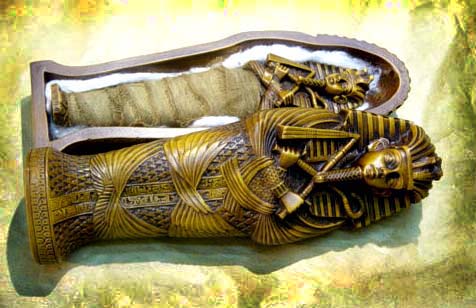
In thousand nine hundred and eight got Lord Karnervon a wealthy British nobles, to permit drilling in the valley of kings goodness, west of Luxor, was then asked to Howard Carter, who was linked to the interests of powers, that is good in the fossil.

According to Carter's Tomb Ththomps IV, Tomb annually and Toya, and then the tomb of Hatshepsut.

He was forced to stop drilling at the beginning of World War One thousand nine hundred and fourteen, but resumed work in one thousand nine hundred and seventeen until November, the first one thousand nine hundred and twenty-two, with the transfer to the drilling site near the entrance to the tomb of Ramses VI.

This was followed four days later, he caught workers to rubble and craters full of broken flint, leads to peace Carved in stone, to the entrance ends impasse Clad mortar, stamped seal of the royal cemetery.

If fossil reveal what was expected, the grandest of what was found in Egypt or in other Egypt, after it had been a cemetery Tutankhamen hiding the extent to which exceeded three thousand years.

head of hatshibsout After the death


After the death Ththomps II, his wife Queen Hatshepsut declared itself the guardian of the throne Ththomps III. Two years later, demanded the throne for themselves.

To be ruled legitimate, claimed that she was born from the Lord Lamont, when embodied in the body of her father Ththomps I, and met her mother Queen The Assembly.

Hatshepsut was portrayed as a man wearing uniforms Royal, composed of the Negev ownership and beard aliases. During the reign of Hatshepsut of Egypt has enjoyed peace at home and abroad, and sent commercial campaigns for Puntland, southern Sudan or Eritrea, the daughter of the temple in the monastery by sea.

Have been recorded on the walls of the temple campaign events, and the legend of the Lord's birth. After twenty years of its rule, disappeared Hatshepsut, the cemetery was destroyed.

Hatshepsut


Hatshepsut: months old Egyptian queen

Hatshepsut was a sister-sister and wife of the king Ththomps II. When the king died, took the judgement of his son after the boy Ththomps third, but Hatshepsut continued to dominate the reins of the country as the guardian of the throne. Hatshepsut enjoyed her life: the queen and subsidiary sent ships in the business tasks of bringing goods alien. When Hatshepsut ruled named king dies removed and scraped off all kinds of tombstones and monuments in the Kingdom. Perhaps the claim to be king - and not just the Queen - was the cause confusion in concepts of His Holiness the Egyptian pharaoh King. But the temple built by the unique honor it stands witness to the times.

Papyrus PHARAONIC


Decorated the walls


Decorated the walls of the courtyard in the era of Ramses II Bmnazer religious and ritualistic We believe the south-western wall, behind the huge statue sitting on the right landscape, carved important, which portrays the building or the temple gate, approaching them princes and senior officials, have brought with them raised decorated earliest, and highlights of the centuries Oxen his enemies from the south and north photographers distinctive feature of the race.
As we see in this scene four huge statues standing in addition to the big statues of the king, sitting in front of the temple said. It should be noted that planning for the same old edifice had pictures on the rear facade of the tower east of the stated terms of showing statues standing in seated statues appear indicating that a change has occurred in the number of statues in front of the building within three years.

the northeastern section


Includes the northeastern section of the courtyard corridor separating the afternoon edifice or gate and pillars of the temple courtyard. Having built a mosque Sir Abe pilgrims in 1243. The debris accumulated in this part of the courtyard of the temple.

The current building is due to the mosque to the nineteenth century, but the minaret of the North due atheist tenth century, which is based on the threshold - a pillar above the horizontal section - from the temple. Every year, at a specified date according to the lunar calendar, is celebrated the birth of Sir Abe pilgrims, where followers to withdraw wooden boat, horse-drawn cart on roaming the city of Luxor. Perhaps this was the celebration of the newly applied to the ancient Egyptian ritual, which is now used to attract tourists.

In the courtyard you can see the back of the eastern tower said the important landscape horticulture. The first scene depicts the head of Eid fertilization Amon - Maine, where the priests carrying the statue. As the young athletes during the celebration of mountaineering lists some wood under the supervision of princes and senior officials. The other is the scene depicting the building as it was in the original planning, led by senior Tmthalan sitting and entertaining.

King Ramses


King Ramses II has stated or Luxor temple gate, and also built the first great extinction. These buildings and additions to the northern temple builders of the original Amnanb III. The edifice 65 m, and has handed the same thickness of the eastern tower leads to higher towers. On the external front said there were four hollowed header found the masts media in the days celebrations. At the highest gaps opened four holes particular, to develop a square pillars which prove masts media. And decorate the front gate or temple edifice panoramic scenes and texts particular location Cadiz famous.

Luxor temple

Luxor temple was built to worship Amon Ra, death and Konso, the gods also called Trinity title Taibi (trinity good), based on an old situation during periods of state of Central and transition II era and the beginning of the modern state.

The main existing temple buildings are those built by angels Amnhotb third - from the family of eighteen, Ramses II - the family of the nineteenth.

Having destroyed the three-cabin, which had been built before in the reign of Queen Hatshepsut, King Ththomps III of the family of eighteen; then reconstructed during the era of King Ramses II.

The kingmakers in future periods to change some mural inscriptions, such scenes Festival "repentance" from my era Tutankhamen and Hormahb; scenes as well as limited sacred compound in the era of Alexander the Great.

Introduction to louxr


Introduction

Luxor city history and civilization, rooted deep in history witness to the greatness of Rights, which marked the Egyptian Sciences and Arts since seven thousand years, which is open to the University of human history in different days through the pre-history and even the modern era.
Location and Area

Luxor governorate map
Luxor is located within the territory at the southern latitudes between 25-36 north east and away -32-33:

* Distance of 670 kilometers southwest of Cairo.
* Distance of 220 km north of Aswan.
* Distance of 280 km south west of Hurghada.

It consists of two parts Alavsr city land east and west Land Chapter Nile River and was known on land in the eastern city neighborhoods Ages Pharaonic temples where religious and palaces of kings and the general public and given to the western city of the dead land where cemeteries and synagogues funeral.

The total area of Luxor, 416 square kilometers including Dahir populated desert area and 208 square kilometres equivalent to 50% of the total area of Luxor.
Economy

1 - Tourism
Luxor to contain the effects of third world and two-thirds of the effects of Egypt and thus the most important areas of historical tourism in Egypt and the world and send them a lot of tourists of various nationalities to view the splendour of ancient Egyptian civilization and the progress of Egyptian art and architecture ..... He was the state interest in Luxor through tourist development projects, a number 23 draft at a cost of 2,019,127,488 pounds and the State maintenance and restoration of monuments and keep them that are a source of national income.

The famous Colossi of Memnon


The famous Colossi of Memnon are all that remains of the burial temple of amon-Ofis III and whose magnificence is recorded in a stele found by the archaeologist Petrie.
These statues, which must have stood to the sides of the entrance to the temple, are 20 meters high; their feet alone measure 2


metres in length and 1 meter in width. Cut in monolithic blocks of sandstone and portraying the Pharaoh seated on his throne, with his hands resting on his knees, the south colossus is in better shape than the other, to which a legend is connected.

It would appear that in 27 B.C a terrible arthquake serverly damaged almost all monuments in Thebes and that an enormous crack opened up from the top to the middle of the colossus, which it toppled. Others, however, attribute this fact to the barbarities of king Cambise and this seems more likely as Egypt has never been prone to seismic movements.

At the time every morning at daybreak the statue gave out a prolonged sound in which some believed to hear a sad, yet harmonious song.

Greek poets soon created a beautiful legend around this strange fact testified by great historians such as Strabo, Pausanias, Tacitus and Philostratus. According to them, the "stone that sings" represent Memnon, the mythical son of Aurora and Tithonus, the king of Egypt and Ethiopia.

Sent by his father to help Troy besieged by the Greek army, Memnon achieved great glory by slaying Antilochus, son of Nestor, but in turn he fell under the revengeful hand of Achilles.

Aurora in tears then beseeched Jupiter to resuscitate her son at least once a day; in this way, every morning, while Aurora was caressing her son with her rays, he replied to his mother disconsolately by wailing.


In actual fact, the sounds were due to the vibrations produced in the sufface which had been broken by the brusque passage of the cold of the night to the heat of the first rays of s
un.


Ramesseum was the name given during the nineteenth century to the funerary temple that Ramses II had built on the west bank of the Nile. His “Castle of a million years” was built by the architect Penre on such a vaste scale, according to Diodorus of Sicily, that it surpassed all other temples at the time. Unfortunaltely, nowadays very little remains of that splendour:

the Osiris pillars still remain on the façade of the hypostyle hall and so does a fallen statue of Ramses II seated on his throne, reminiscent of a defeated giant. It once measured 17 meters and weighed over one thousand tons. Diodorus of Sicily got the Pharaoh’s first name, User-Maat-Ra wrong, and wrote that the statue represented Osymandios.

IMAGES FROM LOUXR PART1


EL DAIR EL BAHARY


One thousand two hundred years after Imhotep, another architect, Senmut, went down in Egyptian history with another architectural master-piece. Queen Hatshepsut, more a benefactress of the arts than a military leader,


commissioned a monument to be built in honour of her father Thot-Mosis I and for herself chose an inaccessible valley which,

consecrated to the goddess Hathor, welcomed the dead in the next world.


Having been abandoned, in Queen Hashepsut’s monument, they installed a Christian convent known as the “convent of the north”, hence the area’s present name of Deir el-Bahari; it was thanks to the insertion of the convent in the Pharaoh’s temple that it was preserved. The architect-minister Senmut had the intuition to make the widest possible use of the dramatic range of ochre-coloured rocks spread out inside.

The design of the monument was also new and avant-garde to the extent that the temple of Hatshepsut, called Djeseru or “the most magnificent of the magnificent” by the ancient Egyptians, is unique in Egyptian architecture.

The temple, which faces eastwards, was a series of vast terraces, which, by means of flights of stairs, ascended to the sanctuary.

An avenue of sphinxes and obelisks provided access to the first terrace, enclosed on the far side by a portico consisting of 22 pillars and flanked by two Osiris pillars.

On one of the walls, bas-reliefs narrate the birth and childhood of the queen and the expedition that the sovereign promoted in the mysterious country of Punt, perhaps what is known as Somalia nowadays, as they feature giraffes, monkeys, panther skins and ivory objects.

On the far wall, 18 large and small niches were supposed to house statues of the queen, both seated and standing.

This temple is characterized by its 16-corner pillars, so admired by Champollion, who called it protodoric.

The entire left part of the valley, however, was occupied by the gigantic burial temple of Montu-Hotep I. Five hundred years before Hatshepsut decided to built his temple in this valley, Pharaoh Montu-Hotep I had the same idea and built his tomb along the typical lines of the Old Empire but tending towards the tombs of the New Empire.

The monumental complex of Montu-Hotep I was formed by a gigantic tomb with a pyramid featuring the king’s grave in its centre.

IMAGES FROM LOUXR PART 2


In Luxor proper on the East Bank


Avenue of SphinxesIn Luxor proper on the East Bank, one of the first stops must be the Temple of Luxor built by Amenophis III. Head south on Sharia al-Karnak to reach the temple, which was connected to the Karnak Temple via a long stone processional street called a dromos. The dromos (Picture at right) was built by Nectanebo I, and originally was lined on either side by sphinxes. In front of the Luxor temple, the dromos is well preserved, and on the way to the entrance one passes by a Roman chapel of burnt brick dedicated to the god Serapis, which was built during the rule of Hadrian. There is a path that leads to the Nile side of the Temple where one enters the complex.

The Luxor Bazaar
One of the Luxor Bazaars

After leaving Luxor, head back to Sharia al-Karnak and go north towards Karnak. Down the road, near the police station which is near the tomb is the oldest mosque in Luxor, the El-Mekashkesh Mosque. It contains the remains of a 10th century Islamic saint who rumor has it was a monk prior to converting to Islam. The mosque is a popular pilgrimage destination. Here also is the Franciscan Church and its schools, one for boys and the other girls. Beyond this lies a great Coptic basilica.

At the Police station, head towards the Nile Corniche. Here, opposite the Mina Palace Hotel you will find the Mummification Museum, which has most anything you would ever want to know about mummifications. From here, head north towards Karnak.

are you wish to be there

Valley of the Kings


A grand statueTo arrive at the entrance one follows the dromos with its crio-sphinxes. They have the head of a Ram and the body of a lion and are symbolic of the God Amun. Arriving at the temple, there is a statue of Ramesses II with his son between his feet.

To the right is a structure that has red steps, a red front colonnade and red brick walls. Inside there are pedestals. inscribed with the names of Roman emperors, that once held their statues. This was a Roman chapel dedicated to imperial worship. After leaving the Temple complex on the left is the Franco-Egyptian Center which has managed the temple complex since 1967. Down on the shore of the Nile is the Centre National dl la Recherche Scientifque, or CNRS, which houses the French and the Chicago House, a project of the University of Chicago is near by.

After this, you will wish to take a boat trip over to the West bank. This trip had a special meaning to the Egyptians, for they were more crossing the way to the West and life, then to a necropolis. The Valley of the Kings is as good as any to try first, with tombs from the 18th and 19th Dynasties. Outside the Valley of the Kings, the road leads past Antef, named for the 11th Dynasty prices who were buried here. Some tombs can still be seen as one heads towards the Temple of Seti I. Most of what is left of Seti's Temple is the view. The court is entered by the ruined gate of a pylon The court has what is left of a palace on the south side. The road continues south passing Dra-Abu el-Naga necropolis.

Wall sculptureWall sculpture

Sculptured Walls

The road eventually winds itself westward until reaching the Valley of Asasif. These are 25th and 26th Dynasty tombs. At the end of of the Valley of Asasif at the foot of a cliff named Deir el-Bahri is a spectacular complex of temples. The Temple of Mentuhetep I, Hatshepsut and Thotmose II here must be seen. Much of the architecture here seems so very powerful against the towering cliffs in the background. From here, the road continues past the remains of the temples of Ramesses IV and Thutmose III, eventually reaching the Necropolis of Sheikh Abd el-Qurna. This 18th Dynasty necropolis sits amidst houses where there are hundreds of holes. And below here, one comes to the famous Ramesseum, built by Ramesses II, a huge complex that took twenty years to complete.

As the road runs along past the remains of Thutmose IV, Merneptah, Ay and Horemheb's Temples, it finally comes to the huge complex known as Medinet Habu, which is another of Thebe's major attractions and a must see sight. The gate has square towers and appears almost oriental. Behind the complex is the workmen's village called Deir el-Medina. Out in the fields near here is the Colossi of Memnon, one of the major tourist attractions throughout time. Southwest of Deir el-Medina is the Valley of the Queens, where queens of the 18th and 19th Dynasties were buried.

From here, the road continues past the mudbrick remains of the Amenhotep III's palace called Malkatta. There is a lake to the east and at the other end of that, a small Roman temple called Deir Shelwit and built at the end of the 1st century.

Luxor Sound and Light Show

Luxor has a wonderful Sound and Light Show